


After yesterday’s T-Mobile-Sprint merger news dropped, I’ve been trying to figure out which side I’m on because this is potentially a really, really big deal for the US wireless industry at multiple levels. At this time, it’s hard to say definitively what will happen, even as T-Mobile and Sprint try and say all of the right things about the situation. So let’s talk through some of this together and see where we end up.
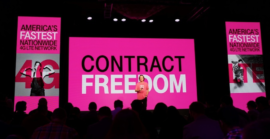
The best place to start is probably with the investor presentation (PDF) that T-Mobile released with yesterday’s announcement, as well as this new All for 5G website dedicated to spreading the message of the merger. The message is pretty clear at both: T-Mobile and Sprint together think they can build a 5G network faster than anyone, create jobs, keep up the Un-Carrier moves that have helped T-Mobile gain success in recent years, and…actually, those are the goals.
A first 5G network
If we look at these in order, that lets us dive into their 5G buildout. According to Sprint and T-Mobile, their combined network resources should allow them to “build the first broad and deep nationwide 5G network.” They’ll do that using the substantial low-band 600MHz spectrum that T-Mobile has, along with Sprint’s 2.5GHz mid-band, while filling in higher-trafficked areas with millimeter Wave (mmW) spectrum. That combination offers a pretty compelling case for them to be able to build a 5G network that is indeed “broad and deep.”
T-Mobile says that it will use the T-Mobile network has the anchor network, while keeping select Sprint sites and increasing density and coverage. They’ll then use Sprint’s 2.5GHz spectrum throughout T-Mobile sites and build thousands of macro and small cells.

Part of the pitch here is that building this 5G network quickly enables the US to continue leading in global internet advancements. And that’s cool, I guess. Being early to a big, fresh wireless tech like 5G can increase innovation, add economic value, and of course, create jobs within this new T-Mobile as well as outside of it.
As for their ability to build this 5G network in a hurry, I think on paper it certainly shows that they’ll have the assets to do so. Individually, their spectrum holdings probably would have made this a slower process, but together, it kind of seems like a match made in heaven, assuming they can acquire more mmW spectrum.
Job creation will probably happen too
The next big goal of this merger is to add to the economy by creating a ton of jobs. T-Mobile has already made it clear that they think this merger will allow them to do so like it did with MetroPCS, even though people told them their acquisition of MetroPCS would do the opposite. While I’m no job creation specialist, it’s pretty obvious that building out a 5G network, along with thousands and thousands of new sites will create jobs, even if temporarily. T-Mobile has estimated 800,000 jobs in construction alone.
Sprint and T-Mobile want to build a network that can truly compete with Verizon’s, but they also want to do so in a hurry. In order to do that, they are going to have to increase their head count. They’ll need a bigger workforce to do that. They’ll also need staff in new areas as their retail footprint increases.
With that said, there will be consolidation. As these two companies come together, you have to consider the fact that we probably don’t need to flip the Sprint store that is two blocks from a T-Mobile store. Of course, support staff will need an increase to address the number of combined customers, but again, there will be overlap in areas that might see cuts.

What about customer prices, though?
Alright, we’re finally getting to the part most of you probably all care about as customers – what will prices look like? As I mentioned above, we don’t know. T-Mobile and Sprint are promising “unmatched service at lower prices for more consumers.” And we know that T-Mobile has certainly done that to an extent with their Un-Carrier moves. We’ve seen 2-year service contracts end, the return of unlimited data, better international features, etc. But will Sprint and T-Mobile together give us more of that?
This merger changes the US wireless landscape from 4 big carriers to 3 big carriers. If we look at Canada, as some have already pointed out, that hasn’t exactly been awesome. Canada’s wireless costs are stupid expensive, they often lock you into ridiculous 3-year contracts, and the three players haven’t had much of a reason to compete with each other. Just imagine that there’s a possibility of that happening here.
You should also take into account the fact that building out a big, fast 5G network before anyone else will be expensive. What happens when you build out big, expensive things in a hurry? The cost of such buildouts could land on your bill. Look at Verizon as an example of that. Sprint already told us that 5G would bring about price increases too. T-Mobile is suggesting that scaling operations should help them to “sustainably compete at lower prices,” but you should be skeptical of that for the next few years as they pour all sorts of cash into their network.
So will prices drop with the new T-Mobile in the end? Honestly, that seems like a foolish bet to take. Will Sprint-T-Mobile be able to keep prices lower than Verizon and AT&T? Yeah, maybe, which is all they are saying. If Verizon and AT&T increase prices as they build their own 5G networks, T-Mobile doing the same but at a slightly lower rate is still an increase. Let’s not get those two items confused here. Prices will more than likely go up as these wireless companies build 5G networks, it’s just that T-Mobile is saying that they should be able to keep their’s lower than the big two. I’ll let you decide if that’s OK.
The takeaway…
I don’t know if this is a good idea or not. I wish I had the answer for you. In the short term, if this helps T-Mobile build a bigger, faster 5G network for us all to use, that’s got some benefits. There are also potential negatives there in the form of price increases as that happens. But look, creating thousands and thousands of jobs, assuming this merger does that, is never going to be something to complain about. If T-Mobile shows up in areas that it wasn’t previously available, that is a new choice for people and new choices are good. Of course, Sprint going away is the removal of another choice too.
So yeah, this is a tough one. There are some good things that could come of this, but the long-term future is what should have people worried. Will we be the next Canada or will T-Mobile stay the Un-Carrier and push Verizon and AT&T in the right direction as they have the past few years? Will Sprint not being there at the bottom as a possible check on T-Mobile turn T-Mobile into the two carriers it so despises?
Insert shruggy emoji.







This hasn’t been approved yet by the government.
Random Brit here. From visiting this site and reading the comments often I get the impression that Sprint was on life support anyway and didn’t offer any effective competition to the others. Is that an accurate impression to have?
that would be accurate. Sprint has been dead for a while, Softbank bought them to try to bring them back, but they honestly haven’t been a big or relevant for much since the early days of smartphones. I’m saying that as a previous employee of both a Sprint and 2 of the biggest Verizon indirect retailers.
I personally don’t like the move ultimately because of less competition, but more particularly harder for even more competition (e.g. more than just 4 big).
This is just a hypothetical for argument’s sake, but say that Google or Apple or Bill Gates or whoever has been internally working on some revolutionary technology and now wants to enter the wireless market and decide the quickest path is to buy out the struggling Sprint with the intention of throwing more money at the newly acquire network base while launching their new technology.
Rarely do specialize technology giants just die out and completely vanish, they may become faint shadows of what they once were (Nokia, Blackberry), but generally evolve or survive is some form or fashion. The main point, even with something dies something else grows and thrives in its place, and I’d rather see two smaller companies like T-mobile and Sprint to either step up their game or leave the door open for something new–it is much harder displace a larger company which ultimately leads to less competition.
Not at all interested in 5G. The prices are going to be over the top and I am not at all interested in spending anymore. And if forced to, it’s back to the stupid phones. Not playing price increase games anymore. Happy with Straight talk on Verizons network. Finally got some price relief.
Does anyone ever truly choose sprint? You go to them because service from legit carriers is outside of your budget and/or your credit sucks. We have prepaid for all that. They need to go lol
Sounds to me like t-moble plans on jumping into the media content and home internet space with 5G. This would also make them an alternative to the cable companies as well.
I guess this is mostly for the sake of discussion, but here’s my question: Is our current 4G data service so bad that this evolution to 5G is worth the higher pricing and removing more players from the game? Are we, as consumers, really not happy with where we are at right now? (Aside from those who were originally subscribed to only Sprint, in which case none of them are happy with the current state of cell data, haha) I’m not saying one way or the other is right. Just throwing the topic out there. Personally, I don’t think it is <- My opinion
5G isn’t going to raise prices. Where are on earth did you get that.
That kinda thinking is what people would use to argue against cars when horse and buggy works fine. Why would you not want to progress technologically? And if you’re personally happy with 4g, you can stay on a 4g plan either on your carrier or a smaller MVNO. By the time everyone has 5g and it is the new default the price will have gotten cheaper. Early adoptors always pay a premium.
None of the articles I’ve seen so far have acknowledged the fact that Sprint was FAILING. Without this mergers their viscosity was in serious doubt, leaving us with three or possibly only two national carriers. I’d rather see T-Mobile thrive with this acquisition than watch AT&T or Verizon scoop up its assets in a fire sale.
If you think John Legere won’t be a Lowell McAdam if given the opportunity, I think you are mistaken. Legere only has the scrappy underdog attitude / techniques because he has too. They were in a distant last place. He answers to shareholders, not customers….and given the chance he will maximize profits (higher prices). I like him, he seems decent, but don’t be fooled. You rarely get the opportunity to add competition so definitely never remove competition.
Shareholders and all business ultimately answer to customers, since customers can exercise their right to simply leave if they don’t agree with your value proposition. And there’s no better way to lose shareholders’ trust than to start losing money by hemorrhaging customers.
Um, actually that’s the goal of all business activity, not just John Legere. And no, maximizing profit does not always mean raising prices. In fact, lowering prices most often allows a firm to maximize profit because they gain more customers. It’s more profitable to sell a $10 product to a million people than it is to sell a $1000 (similar) product to a hundred people. The goal to maximizing profit is meeting demand, and that is typically accomplished through lower prices.
Sprint was simply not competitive. The market should become more competitive with this move (although not guaranteed).
We’ll just have to agree to disagree.
LMAO
Haha
Well, all things considered, these slides show nothing new.
I first saw them when Sprint’s former CEO, Dan Hesse, launched what was then called “Vision Network” designed by Sweden-based Ericsson. It’s “Basic Network Design 101”.
One major change however— now they’re pink instead of yellow.
It’s still troubling when a company has to justify network investment to customers using charts that depict coverage.
Considering Verizon basically owns the FCC, I wouldn’t count on the merger getting approved.
I’m not sure, Verizon likes less competition too.
This move does not result in “less competition.” Fewer competitors =/= less competition. Competition has almost nothing to do with the number of competitors, it has to do with how well existing firms in an open market meet consumer demand. This merger may very well result in MORE competition in the market as the combined entity may be able to serve customer demand better than before.
What’s limiting competition in the market isn’t mergers. It’s government regulations that make it so expensive to enter. But there are a dozen different providers in the market now and new ones pop up every few months. There are no wireless providers who have any semblance of pricing power. Every time one of them wants to raise rates or drop features, they lose customers and it gets blasted in the media.
Care to share some examples where less competitors have actually resulted in more competition. Less competitiors = easier to collude – just take a look the price fixing that takes place in oil production, and the artificial scarcity they create by agreeing to reduce production to drive up prices.
It sounds like you’ve been drinking too much of the pro-corporate capitalist koolaid.
Collusion in a free market is next to impossible. They are such fragile schemes that all it takes is a single participant to realize it’s more profitable to break the compact and steal market share by undercutting his competitors for it to completely disintegrate. Collusion is not eased by there being fewer number of participant firms. It is eased by there being legal barriers to market entry that prevent firms from entering a market and thus undercutting established firms.
Care to share some examples where collusion exists in an open market?
You’re talking about OPEC, presumably? But OPEC was forced to undercut the market and lower prices due to the advances in fracking! We have low gas prices thanks to so-called “collusion” (which doesn’t actually meet the definition of collusion).
Corporations WANT regulations because it makes it easier to collude and raise prices by preventing competition. There’s nothing “pro-corporatist” about supporting a merger that will result in more competition. Mergers are not an example of collusion, price fixing, or any other anti-competitive behavior. You’ve been conditioned to believe wrongly.
SMH… Wow, I don’t even really know where to start. I considered addressing that, but I’m certain it’d just be an example of diminishing returns. Good day…
You want to know where real collusion exists? Look in the halls of Congress.
Well, that’s one thing we can agree on.
what I have not seen one person post is that this move will make the combined tmobile after eating sprint the #1 wireless carrier by subs.
I read that the combined T-Mobile would be #2 behind Verizon. That begs the question why would T-Mobile bother still being the competitive Un-carrier? Let’s not forget T-Mobile started being aggressive only after the merger with ATT fell flat. We are getting nickeled and dimed already by our ISP’s. Comparing cellular prices with the rest of the world I’d say we are at the higher end as well. I am very much on the fence about this merger.
Yeah if you look at the q1 results for both companies in total connections they would be bigger than verizon… I really have no idea where they get this data from. To me it should be reported in total connections.
The entire reason that T-Mobile became the current T-Mobile will be rendered moot once/if this happens. Right now, they (and to a lesser extent Sprint as well) make moves that upset the 1-2 lockstep AT&T and Verizon are in because T-Mobile (and to an extent Sprint) doesn’t want to be the dead last 4th place wireless carrier. if that’s rolled into just 3, unless they’re super ambitious and want to see how close they can fight for number 1 or comfortable 2nd they could very easily indeed pull a Canada and chill as ‘one of the big three’ and as long as all 3 companies are reasonably close, why bother with competing anymore?
Also… for this 5G stuffz, I really do hope this time T-Mobile means REAL 5G… not like back when they pushed how they too had “4G” that, ya know, wasn’t actually 4G for a long time
I too have been stuck in the Big 4 mentality for awhile now and it’s hard to get out of that. But if you take what they are saying at face value, then at least you have to admit the lines are now blurred. Here’s an excerpt of the video’s transcript:
“Because reality, this industry is no longer just 4 wireless companies. Industry lines are blurring and wireless, video, and broadband they’re all converging. AT&T is now the number one TV provider in this country. Comcast entered wireless last year and not in more postpaid phone customers than AT&T and Verizon combined! Charter is launching Spectrum Wireless this year. And more than 1 in 10 Americans already uses wireless as their only internet access. They have no home broadband at all. It’s not the big 4 anymore, its the Big 7 or 8.”
So… no offense, but, since when has a corporate video or public slide show explaining why they’re doing something ever been something to be taken at face value (especially when they’re telling you that it’s gonna be fantastic for you and super consumer friendly) in the history of ever? They’re gonna tell you how ‘fantastic’ it’s gonna be and spin and skew facts because that’s what’s in their interest. Also… last I checked? “Boost Mobile” is a sub-brand, US Cellular, and Cricket don’t even own their own cell towers or anything so their rates are effected by current market trends and anything and anyone else is, again, a sub-brand of one of the big 4 networks. This isn’t like back when Alltel and Nextel existed. these “other companies making up 7 or 8 wireless providers” aren’t fully network-owning/managing Carriers, they’re RESELLERS or sub-brands, and in many ways are just as at mercy as we are to the main Carrier whims.
Also, let’s face it, Cricket, etc… aren’t going to somehow, suddenly, compete with Verizon, AT&T, T-Mobile, etc… for the same customer groups. They can’t.
And what the heck does TV providers and Comcast and Cable have to do with Wireless Carriers? that’s like saying having only one power company in your area works great so why isn’t it bad to only have one wireless carrier? they aren’t even the same thing. This is exactly what I mean about the fact and narrative spinning and skewing that corporation’s do and that T-Mobile and Sprint are spoon feeding. There’s a big difference between Cell Phones and Cell Carriers, and broadband companies in other segments and honestly I will never take a providers word (in any broadband or service segment of the market) at face value. it’s in the best interest to not be fully truthful, play up a preferred version of the truth and spin, skew, blur and mix facts. They aren’t in it for the customer, they’re in it for their profit margins and shareholders/stakeholders
You have some good points. However, they’re definitely not talking about MVNOs because there are like a hundred of those and they’re almost all small. I think they’re talking about companies that have yet to launch their nation-wide networks but who probably have plans of getting into the 5G revolution somehow. Any one of the big tech giants is capable of it — Google, Apple, Amazon, Netflix, Facebook, Dish, Vivint, etc.
Do they have spectrum? That’s the necessary thing. Aside from maybe Dish, and incomplete, random spectrum portfolios (if at all) of others. I don’t think anyone has a comprehensive enough spread of spectrum to become a tower wielding full carrier. mmW spectrum is too short range and non-penetrating to work without mid and low frequency bands as well or you end up like Sprint has struggled with. They have a crappy low band (if much of any) spectrum to operate on if I recall (that or at least in AZ they are just bad with tower amount and placement), so they have issues either buildings and such.
There’s just a lot that goes into being capable of running your own towers and we have to look at where everyone who owns cell traffic frequency spectrum is to get an idea
“And what the heck does TV providers and Comcast and Cable have to do with Wireless Carriers? ”
Comcast is a Wireless Carrier, for example. Charter will be later this year.
The point you so adroitly missed; They are not, in fact, TV providers any more. The landscape has changed.
No… Comcast is not, they are using Verizon towers, they are not a sole managing wireless carrier with their own towers. Nor will be Charter.
So, the point is still valid. What does someone running a cable broadband network have to do with a wireless Carrier? How does talking about TV and cable broadband internet have anything to do with whether or not your wireless carrier merger is good for the customer at all or how does any of that blurred and unrelated conversation have anything to do with justification for why a wireless carrier merger may or may not be good?
Well okay then. MVNOs don’t count. News to me, but hey – limit it however you want, I guess?
Dish Network is the only company that has the power to be a true competitor with the top 4. Charter and Comcast do not have a large, nation-wide portfolio of spectrum. I can start my own MVNO right now, but it will piggy-back off one of the top 4’s networks, that’s what Comcast and Charter are up to. They realize that there are some people who refuse to sign up with their service if they cannot bundle their phone service with it. AT&T, Verizon, T-Mobile, Sprint, and Dish Network are kings of wireless and have the power to offer service throughout the US. Any other “phauxne” companies are suckling at the teat of one of the top 4 behind a facade of being independent.
They’re definitely not talking about MVNOs because there are like a hundred of those and they’re almost all small. I think they’re talking about companies that have yet to launch their nation-wide networks but who probably have plans of getting into the 5G revolution somehow. Any one of the big tech giants is capable of doing it within 10 years—Google, Apple, Amazon, Netflix, Facebook, Dish, Vivint, etc.
How can any company get into 5G when they don’t even have contiguous spectrum throughout the US to even deploy it on? Those companies you listed do have the capital to buy spectrum, but unless they want to be an MVNO, or change the laws of physics, they’re not going to be big players on their own.
Depends upon whether you’re talking about mobile or fixed wireless 5G and which spectrum, the licensed good stuff in the MHz range or the newer high frequency spectrum in the GHz range. Regardless, launching a nationwide network isn’t just about spectrum, it requires a national fiber backbone and lots of metro and distribution fiber to tie together all the radios.
Good points, they’d have to find another way huh like drones or balloons or satellites or antennas on the bottoms of commercial aircraft. Either that or some breakthrough that perfects Tesla’s idea of a signal travel through the ground.
I’m with Kellen this is very hard to figure out. Having more, not less competition is always a good thing for consumers. But, having T-Mobile be a legit #3 could help them really push Verizon and AT&T, if T-Mobile keeps doing what they have been for the past few years. It is a very hard to balance what will happen. Of course if T-Mobile ever starts going toward the evil ways of Verizon AT&T, there is no going back we are stuck with 3 players and all of the consumers will suffer, while the share holders profit.
How’s this create more jobs? They’re already working on 5g and they’re already talking about not using all of Sprint’s network. This is a job killer. No good things except maybe coverage in my opinion.
Because they will start competing in other industries too kind of like how AT&T does TV and home internet now. Also they claim they will invest heavily in building out 5G which will create a bunch of at least temporary jobs.
This should allow them to build out their network faster, which should create more jobs. They may be temporary, but that’s what they are betting on.
Read the damn article jabroni!
Their point is it’s no longer the big 3 or 4 wireless carriers. That’s the old way of thinking. Here’s an excerpt of the video’s transcript:
“Because reality, this industry is no longer just 4 wireless companies. Industry lines are blurring and wireless, video, and broadband they’re all converging. AT&T is now the number one TV provider in this country. Comcast entered wireless last year and not in more postpaid phone customers than AT&T and Verizon combined! Charter is launching Spectrum Wireless this year. And more than 1 in 10 Americans already uses wireless as their only internet access. They have no home broadband at all. It’s not the big 4 anymore, its the Big 7 or 8.”
Hey look, I’m a progressive Californian here and even I’m convinced this merger is a good thing.
I saw that, but they are comparing Xfinity grabbing a couple of millions subscribers to being a real competitor. That’s just not the case. They are still removing an option here by gobbling up Sprint.
You are right, but you have to look at it from more than just one perspective. Well, I mean, you don’t have to, but it helps.
Cable used to be just TV. Then it was internet and TV, then they added landline phones – now we’re seeing them add wireless. Cellular providers used to be phone/calling and some texting (you had to pay extra for) – now they are by all accounts major Internet Service providers and many are branching out into becoming content providers. The lines have most definitely blurred.
The landscape is not what it was. It is changing, and rapidly. That “couple million” subscribers for comcast’s wireless service was in their first year – In a market that is already saturated. (Most of those folks likely already had wireless service. That’s huge.)
It’s at least worth the thought, even if it doesn’t change ones opinion.
Not to mention, Comcast is an MVNO and all their subscribers ultimately add to VZW’s bottom line…
But they’re also gaining someone who can truly compete with AT&T and Verizon. Let’s face it, Sprint was on its last leg anyway, and T-Mobile, while improving, was still nowhere near touching the subscriber base of AT&T and Verizon. This creates a third “big” option that has the potential to actually compete with those two, which in turn will help out the smaller carriers like U.S. Cellular as well.
Well, there is some mid-information here. First, Comcast is regulated like a utility and also, Comcast is a regional provider.
To get XfinityMobile, you have to first subscribe to TV or cable modem internet.
Comcast does a great job. In areas where Comcast is available, T-Mobile prefers to use a Comcast connection to connect cell sites to the internet nearly 3:1.
Should take a poll of who’s a Sprint/T-Mobile Customer and if so are they happy with their service currently. That way when this merger goes to through we can follow up later to compare the quality of service.
Customer service rankings are pretty clear on that one. 😉
How will they resolve the differences between Sprint’s CDMA network and T-Mobile’s GSM network?
Probably would switch to gsm
Thanks. Makes sense.
this is what i am curious about. in the long term 5g should finally kill off the antiquated CDMA network, but it seems like it could be an issue in the short term and during the transition.
that being said, i would think most of sprints smartphones work in a similar fashion to verizons, in that they mostly have gsm radios built into them, and if the provisioning is taken care of, turning off the cdma radio shouldn’t be that big of an issue.
MetroPCS was CDMA.. they transitioned fine to TMo’s network just fine.
T-Mobile has done this before with MetroPCS. They’ll move everyone off CDMA, offer free devices, and refarm the spectrum.
They said they will “aggressively” migrate CDMA voice to VoLTE.
Whats happens to project fi subscribers?
They will be T-mobile customers using Google as an MVNO.
Pretty much. You can bet that Google has a long-term contract that they’ll still have to support. I wouldn’t be shocked if there are hiccups as Sprint is brought in under T-Mobile. Also wouldn’t be shocked if there are some fine print details that will have to be renegotiated between the three because of the merger, but those should mostly not affect customers (although there might be a period of time where “Sprint” goes “dark” and you only operate on T-Mobile frequencies, so there might be some effect).
I highly doubt it that you’ll be lost in the wash, though.
(…and US Cellular)
My thoughts exactly